Crime Cinema
By Yuri Rutman, Writer/Director & Producer, The Violinist (Filmdemand). Educational content only — not investment advice.
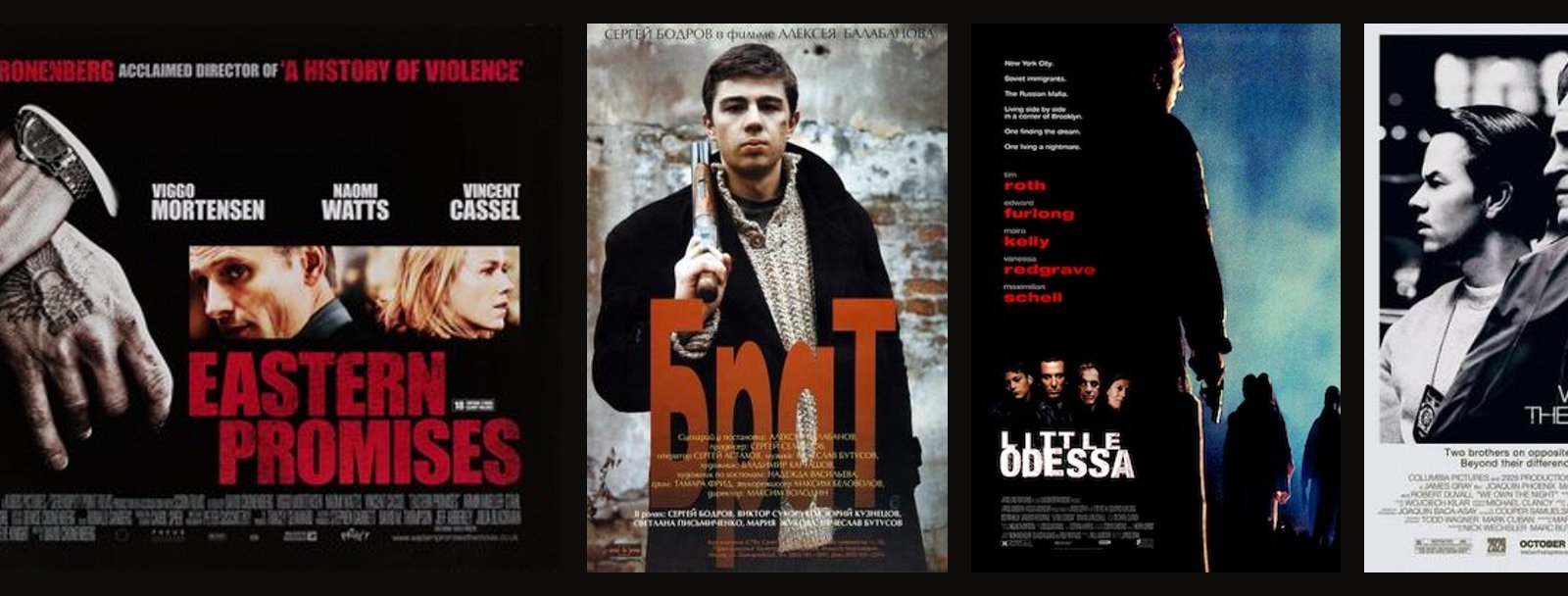
The vory v zakone — "thieves in law" — grew out of the Soviet prison camps with a code of their own. Russian and Eastern European crime cinema tends to strip away Western romanticism, presenting organized crime as a product of state collapse, survival and icy patience rather than family honor.
Essential titles
Eastern Promises (2007)
— theatrical poster, shown for identification and commentary")
David Cronenberg's tense study of a Russian crime family in London, famous for its attention to vory tattoo symbolism and ritual. The most critically recognized English-language Russian-mob film.
Brother (1997) and Brother 2 (2000)
— theatrical poster, shown for identification and commentary")
Aleksei Balabanov's cult films follow Danila Bagrov, a young army veteran, into the underworlds of St. Petersburg and — in the sequel — Chicago. Both became cultural touchstones of the post-Soviet 1990s.
Little Odessa (1994)
— theatrical poster, shown for identification and commentary")
James Gray's debut: a hitman returns to Brooklyn's Brighton Beach and the Russian-Jewish émigré family he left behind.
We Own the Night (2007)
— theatrical poster, shown for identification and commentary")
Joaquin Phoenix and Mark Wahlberg as brothers on opposite sides of a Russian mob war in 1980s Brooklyn.
More to watch
Sisters (2001) — Sergei Bodrov Jr.'s directorial debut, showing how criminal debt engulfs a family.
Bimmer (Bumer, 2003) — A cult road film about four small-time criminals on the run across rural Russia in a stolen BMW.
The Drop (2014) — A Brooklyn bar used as a money drop for Chechen gangsters.
How the Eastern European crime story differs
| Traditional Cosa Nostra films | Eastern European crime films |
|---|---|
| Bloodline and neighborhood loyalty | Survival, opportunism and institutional collapse |
| Protection rackets and street territory | Smuggling, trade and cross-border networks |
| Operatic family drama | Cold, unsentimental realism |
Audiences who know every beat of the Corleone story are finding something fresh in these films: different codes, different histories and a sharper edge.
Why this matters for new crime films
That freshness is one reason filmmakers keep returning to the émigré underworld. The Violinist, an independent crime drama set in Chicago's Eastern European underworld, works in this tradition. If you're curious about the business behind films like these, read the business of making crime films and how movies make money. Film investment is speculative; past success of other films says nothing about any future film.
Frequently asked questions
What is the best movie about the Russian mob?
Eastern Promises is the most critically recognized English-language example; Brother is the defining Russian-language one.
What does "vory v zakone" mean?
"Thieves in law" — a criminal fraternity that originated in the Soviet prison system with its own code and hierarchy.
Are there Russian mafia movies set in America?
Yes: Little Odessa and We Own the Night are set in Brooklyn, and Brother 2 moves partly to Chicago.
Request investor materials
Related guides
Educational information only. Not investment, legal, or tax advice, and not an offer to sell or a solicitation to buy any security. Any offering is made only to verified accredited investors through definitive offering documents. Film investing involves substantial risk, including total loss of capital. Statements about Section 168(k) reflect current law; statements about a federal 20% production credit refer to pending legislation that has not been enacted. Consult your own advisors.