Crime Cinema
By Yuri Rutman, Writer/Director & Producer, The Violinist (Filmdemand). Educational content only — not investment advice.
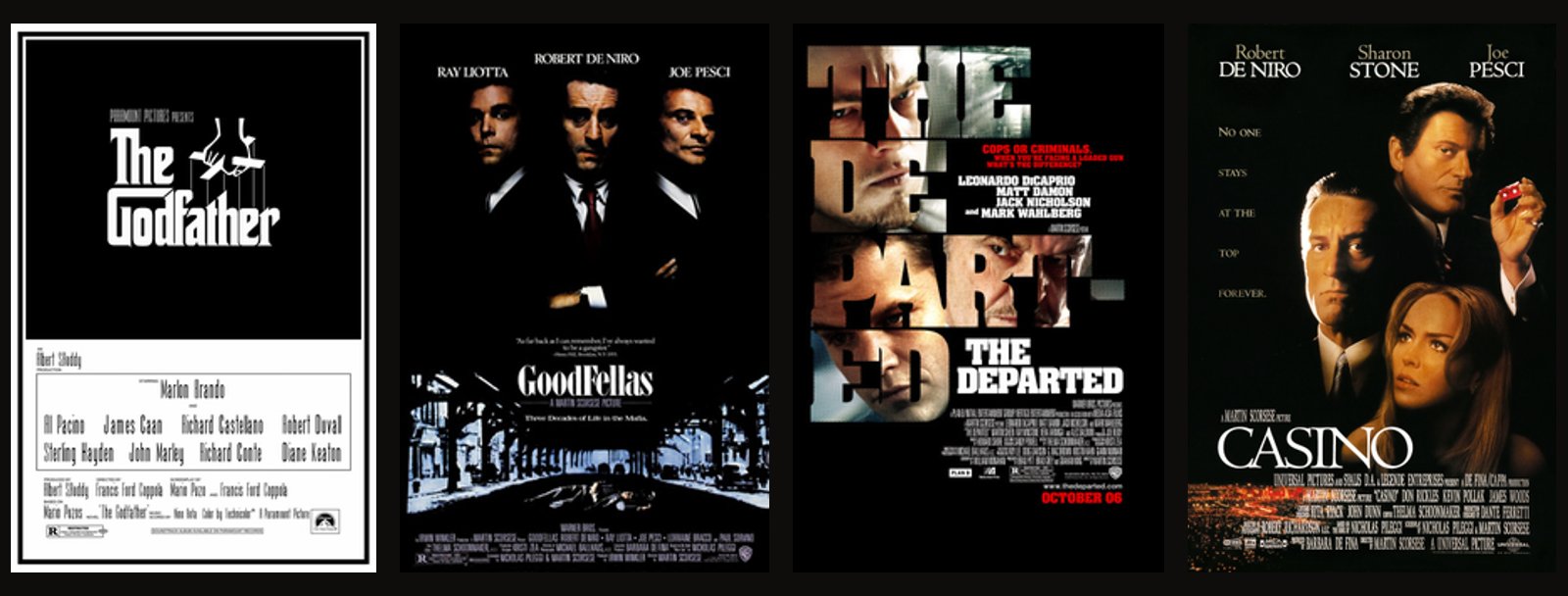
The mafia movie is one of cinema's most durable genres because it puts family, loyalty, violence and ambition inside a closed world with its own rules. We don't just watch these films — we learn their codes of silence, their dinner-table rituals and their inevitable downfalls.
This ranking weighs filmmaking craft, influence on later movies, performances and rewatch value. It folds together three overlapping traditions: Italian-American crime-family sagas, the broader American gangster film, and organized-crime cinema from around the world.
The top 10
1. The Godfather (1972)
— theatrical poster, shown for identification and commentary")
Francis Ford Coppola turned Mario Puzo's novel into an opera of generational corruption — the mob as a family dynasty. It won the Oscar for Best Picture and still sets the standard every mafia film is measured against.
2. Goodfellas (1990)
— theatrical poster, shown for identification and commentary")
Martin Scorsese's kinetic, street-level portrait of mob life, adapted from Nicholas Pileggi's book Wiseguy. Where The Godfather is formal, Goodfellas is fast, funny and frightening — the mob as an intoxicating lifestyle.
3. The Godfather Part II (1974)
— theatrical poster, shown for identification and commentary")
A sequel and a prequel in one, contrasting young Vito's rise with Michael's cold consolidation of power. Also a Best Picture winner.
4. Once Upon a Time in America (1984)
— theatrical poster, shown for identification and commentary")
Sergio Leone's sprawling, melancholic epic of Jewish-American gangsters, friendship and betrayal across half a century.
5. The Departed (2006)
— theatrical poster, shown for identification and commentary")
Scorsese's Boston undercover thriller — the mob infiltrating the police, and the reverse. It won Best Picture and finally earned Scorsese his Best Director Oscar. It remakes the Hong Kong film Infernal Affairs.
6. Casino (1995)
— theatrical poster, shown for identification and commentary")
Scorsese and Pileggi reunite for a neon-drenched autopsy of how greed and hubris destroyed a mob-run Las Vegas operation — the mob as a corporation.
7. Donnie Brasco (1997)
— theatrical poster, shown for identification and commentary")
Mike Newell's drama, based on FBI agent Joseph Pistone's account, captures the psychological toll of living undercover between two families.
8. Miller's Crossing (1990)
— theatrical poster, shown for identification and commentary")
The Coen brothers' cerebral, dialogue-rich Prohibition-era chess match about loyalty, ethics and the price of being clever.
9. A Bronx Tale (1993)
— theatrical poster, shown for identification and commentary")
Robert De Niro's directorial debut: a boy torn between his bus-driver father and the neighborhood's charismatic boss.
10. Scarface (1983)
— theatrical poster, shown for identification and commentary")
Brian De Palma and Oliver Stone's maximalist, endlessly quoted rise-and-fall story about the dark side of the American Dream.
11–25: The essential rest
The Irishman (2019) — Scorsese's late-career reflection on loyalty and regret.
Mean Streets (1973) — The raw early Scorsese film that introduced his voice.
Road to Perdition (2002) — Sam Mendes's father-and-son story set in Depression-era Illinois.
Gomorrah (2008) — Matteo Garrone's unglamorous look at the Camorra in Naples.
The Untouchables (1987) — Brian De Palma's operatic Prohibition drama about bringing down Al Capone.
American Gangster (2007) — Ridley Scott's story of Harlem trafficker Frank Lucas, a criminal enterprise run like a business.
Eastern Promises (2007) — David Cronenberg's tense look at the Russian mob in London. See our guide to the best Russian mafia movies.
Bugsy (1991) — Barry Levinson's glossy account of Bugsy Siegel and early Las Vegas.
Black Mass (2015) — Johnny Depp as Boston's Whitey Bulger.
City of God (2002) — Organized crime in Rio's favelas.
Infernal Affairs (2002) — Hong Kong triad infiltration, and the film that inspired The Departed.
Prizzi's Honor (1985) — John Huston's darkly comic mob romance.
The Friends of Eddie Coyle (1973) — A quiet, bleak story about small-time criminals.
Gangs of New York (2002) — Scorsese's violent portrait of 19th-century Manhattan.
The Long Good Friday (1980) — A British gangster classic about a boss whose plans unravel.
Italian-made mafia cinema
"Italian mafia movie" can mean American films about Italian-American families, or Italian films about organized crime in Italy. The Italian tradition tends to be far less romantic, showing the toll criminal organizations take on ordinary communities:
Gomorrah (2008) — Based on Roberto Saviano's nonfiction book about the Camorra.
Romanzo criminale (2005) — Michele Placido's story of a Roman crime gang.
Suburra (2015) — Stefano Sollima on corruption, politics and crime in Rome.
The Hundred Steps (2000) — Marco Tullio Giordana's film about Sicilian anti-mafia activist Peppino Impastato.
Where it all started: the gangster foundations
All mafia movies are gangster movies, but not all gangster movies are about the Mafia. The sound-era template was set by Little Caesar (1931), The Public Enemy (1931) and Howard Hawks's original Scarface (1932), followed by James Cagney's White Heat (1949) and Arthur Penn's Bonnie and Clyde (1967), which helped launch the New Hollywood era.
Hidden gems you may have missed
— theatrical poster, shown for identification and commentary")
The Outfit (2022) — Mark Rylance as a tailor in 1950s Chicago whose shop doubles as a mob message drop. Almost entirely one location, carried by dialogue and suspense.
The Drop (2014) — Tom Hardy and James Gandolfini in a tense story about a Brooklyn bar used as a money drop for Chechen gangsters.
Kill the Irishman (2011) — Danny Greene's war with the Cleveland mob in the 1970s.
Fresh (1994) — A young chess prodigy plays rival dealers against each other.
State of Grace (1990) — Sean Penn undercover among Hell's Kitchen's Irish gangsters.
The Funeral (1996) — Abel Ferrara on grief and violence inside a criminal family.
What makes a great mafia movie?
The best entries pair a specific, lived-in world with a universal story: loyalty tested, ambition corrupted, family destroyed by the business that supports it. They care about food, language and ritual — which is why the dinner tables and social clubs stay with us. And organized crime works as a mirror for legitimate institutions: its hierarchies, loyalty tests and succession fights echo business and politics.
That last point is why a growing number of crime fans also take an interest in how these films get financed. If you're curious about the business side, start with how movies make money and the business of making crime films. The Violinist — a crime drama set in Chicago's Eastern European underworld — is one independent production in this tradition.
Frequently asked questions
What is the best mafia movie of all time?
Most critics and audiences name The Godfather first, with Goodfellas the usual runner-up.
What is the difference between a mafia movie, a mob movie and a gangster movie?
Mafia movies focus on structured crime families, often Italian or Italian-American. "Mob" is broader and can include any organized criminal group. Gangster movies cover an even wider range of criminals, eras and cultures.
Which mafia movie is closest to real life?
Goodfellas and Donnie Brasco are both based on real accounts and are often cited for authenticity, though both take dramatic liberties.
What is the best Italian-made mafia movie?
Gomorrah (2008) is the most widely praised.
Request investor materials
Related guides
Educational information only. Not investment, legal, or tax advice, and not an offer to sell or a solicitation to buy any security. Any offering is made only to verified accredited investors through definitive offering documents. Film investing involves substantial risk, including total loss of capital. Statements about Section 168(k) reflect current law; statements about a federal 20% production credit refer to pending legislation that has not been enacted. Consult your own advisors.